
If you find very little time to spare for a daily workout regime but want to stay fit, there is nothing better than Surya Namaskar. Surya Namaskar or Sun Salutation is a set of 12 powerful yoga asanas which provide a great cardiovascular workout. It’s also a great way to stay fit, and retain the peace of your mind and soul.
Let’s start with the paratham asam or the first posture.
1. Pranamasana (Prayer pose)

Pranamasana is the start of your Surya Namaskar.Stand at the edge of your mat, keep your feet together and balance your weight equally on both the feet. Expand your chest and relax your shoulders. As you breathe in, lift both arms up from the sides, and as you exhale, bring your palms together in front of the chest in prayer position.
2. Hastauttanasana (Raised arms pose)
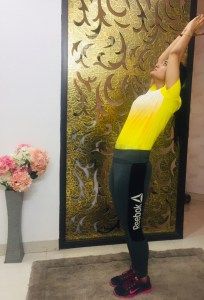
Keeping the palms joined in the previous prayer position, breathe in and lift your arms up and bend backwards slightly. Your biceps should lie close to your ears. This posture is to loosen up your body by stretching the entire body backwards, standing at your tip toes.
3. Hastapadasana (Standing forward bend)
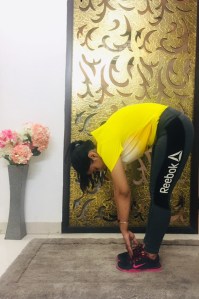
Now breathe out, and bend forward from the waist.Go down and try to touch you’re palms to the ground but keeping your spine erect. Do this as you exhale slowly and completely.I have a back problem so my Spine was not so erect but you please make that while doing this asana your spine should be erect. You may bend the knees, if necessary, to bring the palms down to the floor. Now make a gentle effort to straighten the knees. It’s a good idea to keep the hands fixed in this position and not move them henceforth until we finish the sequence.
4. Ashwa Sanchalanasana (Equestrian pose)
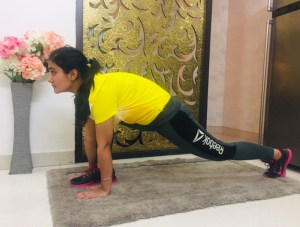
Breathing in, push your left leg back, as far back as possible. Bring the left knee to the floor and look up.Ensure that the right foot is exactly in between the palms.
5. Dandasana
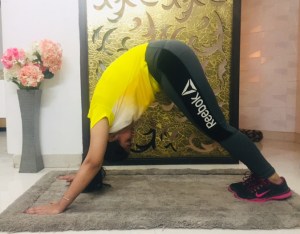
Breathing out, lift the hips and the tailbone up to bring the body into an inverted ‘V’ pose. If possible, try and keep the heels on the ground and make a gentle effort to lift the tailbone up, going deeper into the stretch.
6. Ashtanga Namaskara (Salute with eight parts or points)
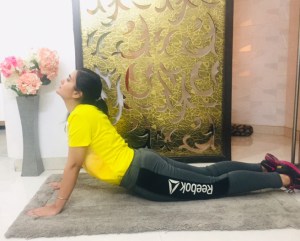
Gently bring your knees down to the floor and exhale. Take the hips back slightly, slide forward, rest your chest and chin on the floor. Raise your posterior a little bit.The two hands, two feet, two knees, chest and chin (eight parts of the body) should touch the floor.
7. Bhujangasana (Cobra pose)
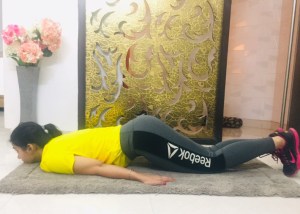
Slide forward and raise the chest up into the Cobra pose. You may keep your elbows bent in this pose with the shoulders away from the ears. As you inhale, make a gentle effort to push the chest forward; as you exhale, make a gentle effort to push the navel down. Tuck the toes under. Ensure you’re stretching just as much as you can and not forcing your body.
8. Mountain pose – Parvatasana
Breathing out, lift the hips and the tailbone up to bring the body into an inverted ‘V’ pose. If possible, try and keep the heels on the ground and make a gentle effort to lift the tailbone up, going deeper into the stretch.
9. Equestrian pose- Ashwa Sanchalanasana
Breathing in, now push your right leg back, as far back as possible. Bring the right knee to the floor and look up.Ensure that the left foot is exactly in between the palms.
10. Hastapadasana (Standing forward bend)
Breathing out, bring the left foot forward. Keep the palms on the floor. You may bend the knees, if necessary.
11. Hastauttanasana
Now inhale, raise your hands upward, and bend backward to enter Ardha Chakra Asana.
12. Pranama asana
Finally, exhale and stand in a relaxed manner in the namaskara mudra. Feel the positive vibrations in your body. This is how you complete one repetition of Surya Namaskar. Twelve repetitions of this holistic exercise are said to yield maximum benefit.
Gently straighten the knees, and if you can, try and touch your nose to the knees. Keep breathing.


 Aadifit